Welcome to the Center for Sociological Research | CIS

Complete Catalog of Studies

Since 1963, the CIS has offered the public an extensive Catalog of Quantitative and Qualitative Studies, providing access to decades of rigorous research and valuable data.

News

82.3% of Spaniards value the contribution of the Constitution to the development of social rights in Spain
  • 17 FEB 2026

The Spanish Constitution of 1978 has become this February the longest-lasting of the nine constitutions that have succeeded one another in the History of Spain, surpassing the text of 1876, something that was known by 49.2% of those surveyed by the February Barometer of the Center for Sociological Research (CIS). The study, conducted between February 2 and 6 with a sample of 4,027 interviews, concludes that 82.3% of Spaniards believe that our Constitution “has contributed to the development of social rights in Spain, to economic prosperity and the improvement of employment (75.3%), and to Spain having a more prominent role in Europe and in the world (71.6%). The most significant aspects of the current Constitution for Spaniards are positive. First, 31.8% say it "guarantees freedom," 21.2% believe it "allows for the peaceful resolution of conflicts," and 15.6% say it "was approved by almost everyone's agreement." 37.3% of those surveyed believe that the Constitution can help solve the problems we currently have, while 58.1% do not believe that it can.

News
El PSOE se sitúa casi 10 puntos por delante del PP en intención de voto
  • 16 FEB 2026

Según el barómetro de febrero del CIS, el PSOE lograría ahora el 32,6% de votos, el PP se quedaría en el 22,9%, VOX en el 18,9%, SUMAR en el 7% y Podemos en el 3,9%. Pedro Sánchez es el líder político mejor valorado con una puntuación media de 4,23; seguido de Yolanda Díaz que logra un 3,97; Alberto Núñez Feijóo obtiene un 3,45; y Santiago Abascal un 2,97. Pedro Sánchez es el favorito como presidente del Gobierno para el 39,7% de los encuestados que dan su opinión, sacando 23,7 puntos de ventaja a Santiago Abascal que lo es para el 16% y se sitúa en segunda posición por delante de Alberto Núñez Feijóo, que es el preferido para el 15,6%, Gabriel Rufián para el 6,6%, Isabel Díaz Ayuso para el 5,3% y Yolanda Díaz para el 4,9%. Constitución de 1978: la más longeva de la historia de España La Constitución española de 1978 que, en este febrero, se ha convertido en la de mayor duración en la Historia de España (algo que sabía el 49,2% de los españoles), es considerada por el 82,3% como una Constitución que ha contribuido al desarrollo de los derechos sociales en España, a la prosperidad económica y las mejoras de los empleos en España (75,3%), y a que España tenga un papel más destacado en Europa y en el mundo (71,6%). El 37,3% confía en que la Constitución pueda ayudar a resolver los problemas que tenemos actualmente, en tanto que un 58,1% no confía en que pueda ser así. Lo más significativo de la actual Constitución para los españoles son cuestiones positivas. En primer lugar “que garantiza la libertad” (31.8%), seguido de “que permite resolver los conflictos por medios pacíficos” (21,2%), y “que se aprobó por acuerdo de casi todos” (15,6%). Un 84,3% cree que la actual Constitución española necesita en estos momentos de alguna reforma, de los cuales un 66,5% piensa que son precisas reformas importantes, y un 32,1% pequeñas reformas. En cuanto a los aspectos en los que se piensa que son necesarias reformas, señalan “en derechos sociales, económicos y laborales”, un 22,1% en primer lugar, y un 14,5% en segundo lugar; seguido a bastante distancia “en el modelo de Estado (Monarquía vs República), con un 10,9% en primer lugar y un 5,6% en segundo lugar, lo que supone solo un 13,8% del total de encuestados, indicando que el 86,2% restante no plantea esta cuestión. A continuación, se mencionan las cuestiones territoriales (10,1% y 6,2%), las garantías de transparencia de la actividad política (8% y 5,3%), los asuntos relacionados con la Justicia y los derechos de defensa (7,3% y 5,2%), la participación y el sistema electoral (7,1% y 4,47%), y los derechos y libertades de los ciudadanos (5,7% y 5,6%). Sin embargo, se registra menos sensibilidad pública en materias muy relevantes y de mucha actualidad, como inmigración (2,5% y 2,6%), igualdad de hombres y mujeres (2,2% y 1,6%), nuevas tecnologías (0,6% y 0,3%) y cuestiones relacionadas con la articulación europea (0,2% y 0,3%) o el medio ambiente (0,2% y 0,3%). Trump y la geopolítica A su vez, en el plano internacional los datos del CIS indican que el 76,5% de los españoles tiene, en estos momentos, una opinión “mala o muy mala” sobre el actual presidente de los Estados Unidos de América, Donald Trump, en tanto que un 15,7% tiene una opinión “muy buena o buena” y un 3,8% “regular”. Sobre la pretensión de Donald Trump de hacerse con Groenlandia, el 83,5% está en contra. Además, el 79,5% considera que Trump supone un peligro para la paz mundial. Respecto a las detenciones, agresiones de migrantes y otros actos de violencia, el 67,4% asegura que se está poniendo en peligro la democracia en los propios Estados Unidos. Problemas en España El principal problema de España, según los encuestados, es la vivienda (42,8%), seguido de la inmigración (20,3%), y la crisis económica y problemas de índole económico (18,1%). Los problemas que los españoles consideran que más les afectan de manera personal son la vivienda (27,6%), que escala a primera posición respecto al mes pasado; la economía (25,8%), y la sanidad (22,9%). Situación económica personal y general El 63,5% de los españoles considera que su situación económica personal es en la actualidad “muy buena o buena” frente al 26,2% que afirma que esta es “mala o muy mala”. En cuanto a la situación económica general de España, el 37,6% la considera “buena o muy buena” frente a un 55,4% que la considera “mala o muy mala”. Invasión de Rusia a Ucrania y guerra en Oriente Próximo Un 70,7% de los encuestados se sienten “muy o bastante preocupados” con la invasión de Rusia a Ucrania, un 15,4% dice que “poco o nada” y un 11,6% se muestra “algo preocupado”. En cuanto a la guerra en Oriente Próximo, un 66,2% se sienten “muy o bastante preocupados”, un 16% asegura que les preocupa “poco o nada” y un 15,6% dicen sentir “algo” de preocupación. Estos y otros datos se encuentran recogidos en el barómetro realizado del 2 al 6 de febrero con 4.027 entrevistas.

Information Note
The president of the CIS praises the legacy of the pioneers of Gender Sociology
  • 10 FEB 2026

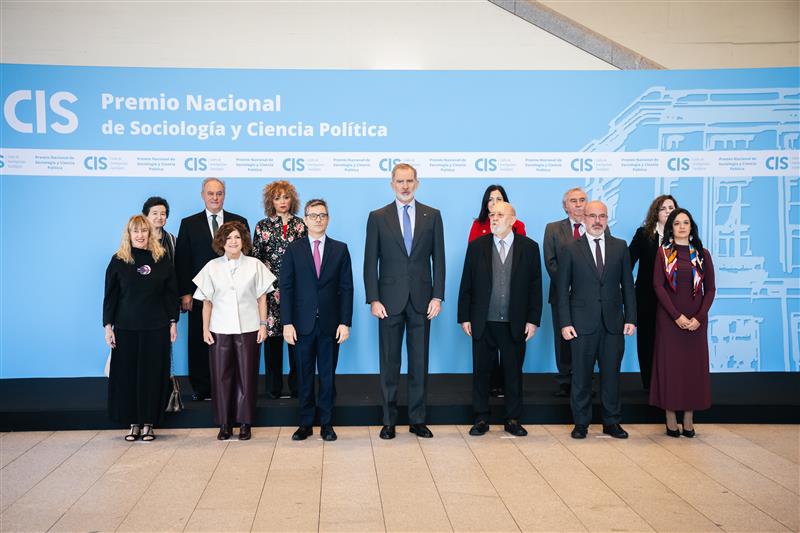
On Monday, January 9, the solemn presentation of the 2025 National Prize for Sociology and Political Science, awarded by the Center for Sociological Research, took place in the auditorium of the Royal Collections Gallery. Capitolina Díaz Martínez , Professor of Sociology at the University of Valencia and the first woman in Spain to study Sociology of Science from a gender perspective, received recognition from His Majesty the King for an intense career of academic and research excellence. In an event led by the Director General of Coordination and Research of the CIS, Silvia García Ramos , the President of the Center for Sociological Research, Jose Félix Tezanos, began his speech by recalling that just eight years ago, in 2018, there was not a single woman who had been distinguished with the National Sociology Prize. Thanks to her personal efforts, the award has since been given to five women: “ They are highly specialized academics in specific areas of Gender Sociology. Their works and research constitute seminal contributions to fields related to the gender policies being promoted in contemporary societies. Therefore, it is important to emphasize that this body of contributions forms a set of innovations and contributions to current Sociology that could in itself constitute a major Treatise on Gender Sociology, allowing us to fully understand what has happened, what is happening—and what needs to happen—in the dynamics of our societies,” Tezanos stated.   The president of the CIS also wished to express his gratitude for the support of His Majesty the King, “who year after year honors us with his presence and his example of commitment to the Sciences and the Arts, and to the most relevant conditions for political coexistence for all and among all. A King who has been fulfilling his role with a high sense of institutionalism, which is also reflected in the sincere recognition of Spanish sociologists and political scientists.” In her laudatory speech for the award recipient, Professor Constanza Tobío highlighted the originality of Capitolina Díaz's thinking, which she termed "sociological imagination," as well as her enthusiasm and tenacity. She praised Díaz's contribution to rescuing the legacy of women sociologists of the past and focused on one of her most original and forward-thinking lines of research: the analysis of gender biases in the application of digital technology and now, artificial intelligence. And then came the moment for the honoree's speech, which already promised much with its suggestive title: "The Social Epiphany of Women and Its Consequences for Sociology." Capitolina Díaz began by thanking and celebrating the support and inspiration of all those men and women who helped solidify her career , and who even shaped her future when she was a student and later a young professor. The award winner reviewed how science excluded women with the acquiescence of brilliant minds and their marginalized status in countless fields, including health, with surprising examples.   And yet, at the end of that analysis, she left us with a cry of positivity: “How dare I proclaim that the women’s revolution is successful? Don’t I see the inequality that still diminishes us? (…) The feminist revolution has consisted of more than two centuries of persevering activism and theoretical creation, which have gradually imposed the presence of women on social norms and political agendas. This process has allowed us to achieve everything from suffrage to enjoying human rights and, in particular, the right to gender equality and reproductive and sexual rights. These are rights that, as they move from law to reality, have effectively made women visible. We can illustrate this visibility with clear examples from our own country: think of the women we see in cabinets, in parliament, in the judiciary, in journalism, in academia, in hospitals, driving taxis and buses, etc. Today we can see women receiving scientific awards. It is true that the Nobel Prizes, for example, are still not exclusively awarded to women.” It's true that, until very recently, only exceptional figures like Madame Curie or María Ángeles Durán received the highest honors. They were still a drop in a sea of men. However, the National Prize for Sociology and Political Science is now making the work of women sociologists visible at a similar pace to that of their male counterparts. And the same has been happening for the last two years with the National Science Prizes. For all these reasons, I believe we can be hopeful and say that women, although still facing persistent and hostile spaces of inequality, have gone from invisible to almost omnipresent. The audience rose to their feet in prolonged applause, and the event was finally closed by the Minister of the Presidency, Justice, and Relations with the Cortes, Félix Bolaños, who emphasized the essential contribution of the Social Sciences to strengthening democracy and fostering a better understanding of Spanish society. He highlighted Capitolina Díaz's commitment to public service, underscoring her solid academic background, prolific research activity, and international standing.

IV Jornadas sobre Sociología del Género 2025

Con motivo del Día Internacional de la Mujer, el CIS celebra el próximo 6 y 7 de marzo, las IV Jornadas sobre Sociología de Género, este año centradas en la mujer y la política.

Ver última convocatoria

Summer Courses

Cursos de verano

National Award for Sociology and Political Science

The award annually recognizes outstanding academics in sociology or political science for their significant contributions to the discipline, either through their research career or a specific work.

Ver último galardón
National Award for Sociology and Political Science

How we conduct surveys

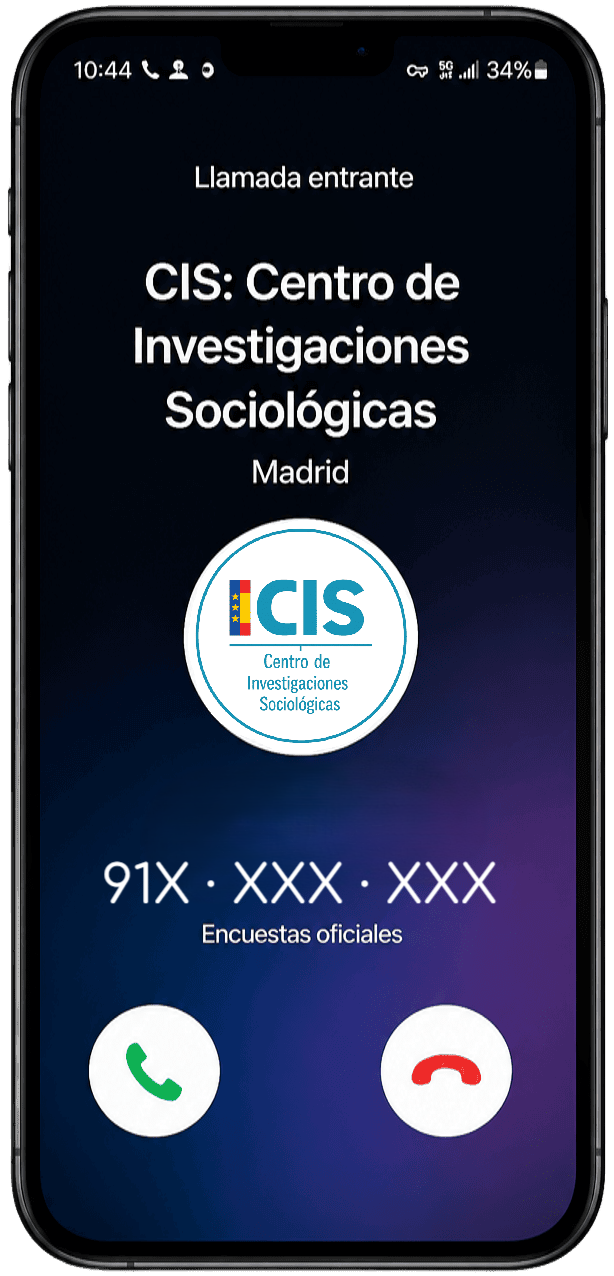
How to know if the phone extension calling you is from CIS?

If you wish to verify the extension from which CIS has called you, you can do so through the following phone numbers. You will be informed about the study being carried out and the phone extension used will be verified.

Mornings Schedule: From 8:30 to 15:30. Contact phone: 678 076 136
 
Afternoons Schedule: From 15:30 to 21:30. Contact phone: 678 076 136

Our History

The history of the CIS dates back to the mid-20th century with the creation of the IOP (Institute of Public Opinion), where the history of our country began to be revealed through the lens of Spanish public opinion.

Get to know our history
Logo del Portal de la Transparencia del Gobierno de España
Logo de Datos Abiertos del Gobierno de España
Logo de administracion.gob.es
Logo del Ministerio de la Presidencia, Justicia y Relaciones con las Cortes